
Seven Years
War tests.
Test three.
With the same composition
of armies and some minor adjustments of terrain both sides deployed a strong
cavalry wing with a main battle line supported by a second line of infantry.
The Prussian infantry formed up in two lines with the fusiliers (conscript)
posted to the right of the artillery. Austrians formed up in a similar fashion with
a Reichs Armee battalion (conscript) forming up to the left of their artillery.

What was meant to be a
test of minor changes for the grenadier performance ended with similar results
as the first two tests. The Prussian grenadiers were destroyed and the Austrian
combined grenadiers never came into hand to hand combat.

At the end of four turns, another
inglorious loss for the Prussians. (2-4)
Test four
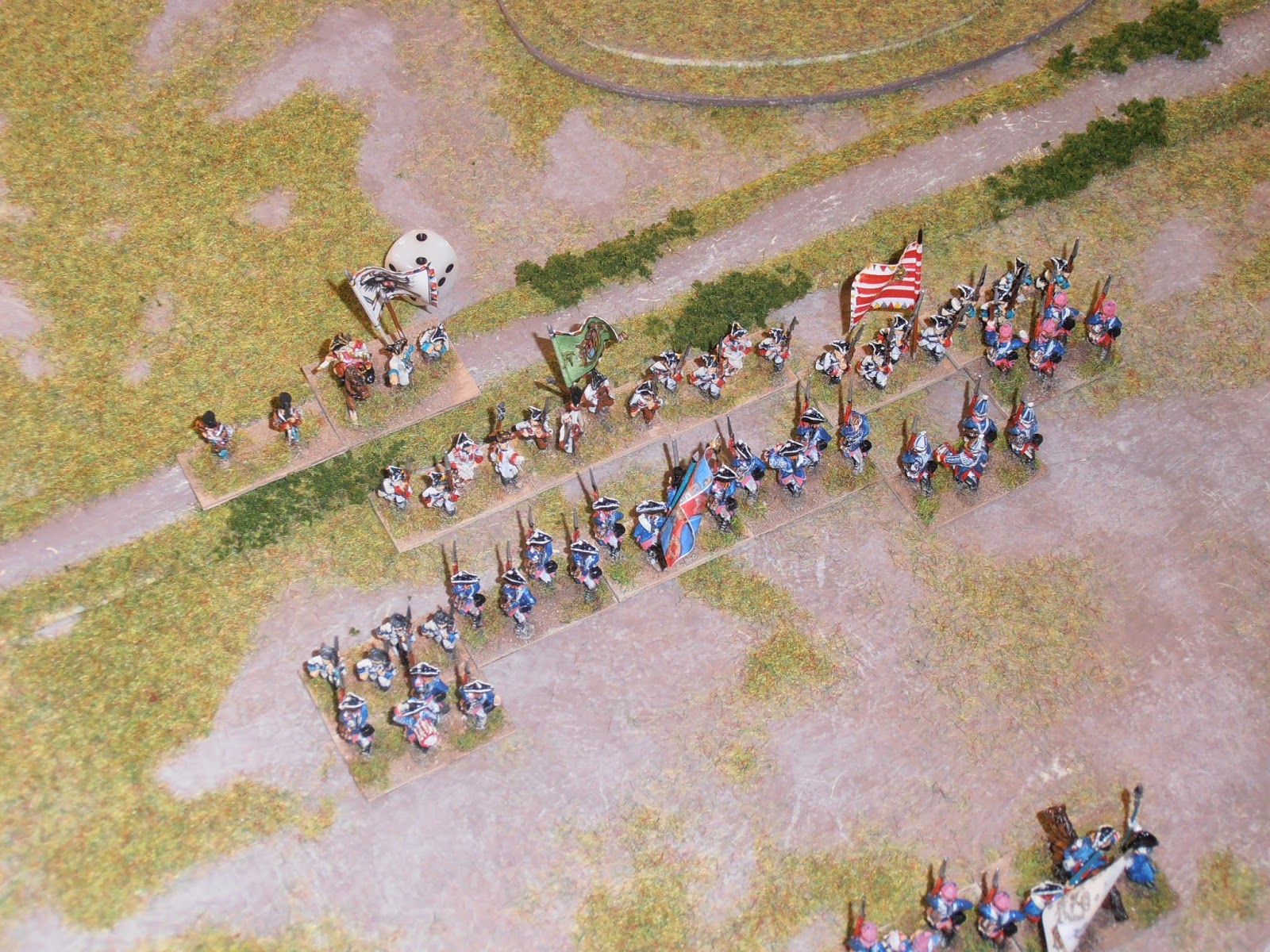
In this last test, I
brought the main battle lines closer and used only the foot elements of each
army. Both lines closed to contact and the grenadiers could now better employ
their effectiveness. Without increasing their combat factor, I gave them
pursuit characteristics of blade (Bd). Still rendering side support for line infantry and
pursuing their opponents these slight modifications brought them closer to what
one would expect of grenadiers.
The last step was to test
increasing their combat factor to +5. This made them extremely powerful and would
require further testing. Historically, not all units titled as such were equal.
I doubt if anyone would contest that British Foot Guards or French Imperial
Guard were equal to Spanish or Neapolitan Grenadiers.
We must not overlook any
changes to factors or combat performance should be valid for the entire range
covered by the variant.
The DBA-HX 3.0 tests will
continue in two days’ time with the Napoleonic period.


