donderdag 19 maart 2026

Return of the Sudanese

The refurbishment of the Sudanese, now complete, has returned to its original purpose as an enemy for an 18th century ImagiNations set in East Africa. The rules used, the War Game Rules 1685 – 1845 have been adapted to make them compatible with the DBA3 system. Supplementing the variant rule set, is a Seven Years War campaign system developed for the European theater and will now include a colonial theme.

The Seven Years War has often been described as a global conflict and for Great Britain, it confronted enemies in North and South America, India, Asia (Manila) and Senegal. The latter had appeal, but would necessitate the purchase of West African natives and that was out of the question. However, moving an Anglo-French conflict to East Africa seemed a better option and so the refurbishment of the Sudanese began in earnest.

A most helpful source, “A History of the Beja Tribes ofthe Sudan” by A. Paul 1954 (available at Archive.org), describes the various tribes and their geographical location. The political background is briefly sketched in chapter IX and does fuel a myriad of possibilities for an imaginary conflict, much of the information is provided by Leo Africanus, a writer on Africa of his time. 

The miniatures.

Meroitic Kush and the Noba before transformation.

Beja warriors


Beja cavalry and camelry


Baggara cavalry and camelry


Emirs


dinsdag 12 augustus 2025

Scenario test - Capture a strongpoint

A defensive position overlooking an important supply route is the objective for this scenario. Held by a battalion of infantry, a small brigade of infantry supported by two squadrons of dragoons have been assigned to capture the position and hold it to the following day. Assault is to begin during the early morning and its capture should be made before noon.

Forces:

A battalion of French occupy the position and these are classed as raw.

The British consist of a battalion of Highlanders and the combined companies of grenadiers, supported by two squadrons of dragons. The latter are positioned off table to will arrive immediately on a roll of a 6 or the expenditure of 4 pips following the Collision Course system.  


Test one.

British troops are seen deploying to line quickly bringing them in range of the fort’s heavy artillery. A courier is despatched to alert the general of the assault.

After scaling the earthwork, the Highlanders engage the defenders. Informed they would find untrained troops defending, the enemy demonstrate a surprising resilience. After losing half their number, Alsace flee and seek shelter behind the newly arrived reinforcements.  


During the action surrounding the capture of the fort, British dragoons had taken a position near the hamlet to guard against reinforcements arriving. They did not have long to wait as French dragoons headed the advancing column. Both sides deployed to line, but the French are first off, the mark and wreaked havoc among the British sending them to flee.  


As dusk approaches, the French general does not have not enough troops to recapture the fort nor to engage the British in a fire fight and so relinquishes the position to the British.


Test two.

The second test was replayed on the same terrain, but with the British attacked from another side. The grenadiers lead the assault while the Highlanders were sent to secure the hamlet and delay any possible reinforcements.

The defense of the fort was tenacious, such that the Highlanders changed direction to join the assault, entering through the back door. This proved too much for Alsace and survivors fleeing wondering why the reinforcements had not arrived.


Observation

Both sides began the scenario with an even number of troops, with the defender having the majority his off table, its arrival would be decided by a die cast. After two relatively easy victories, a number of ideas were come to mind to bring some balance to the scenario. Much should depend on the commanders leading their detachments.

Leader capacity, in this rule system, is described as either cautious, bold or rash. In this scenario, the attackers, lead by a bold general, fought a cautious defender and the quality of troops under each should reflect their level of leadership, in this case, elite and veteran troops attacked raw or untrained recruits.

This might be the direction needed to balance play, cast a die to determine the quality of their general and troops. One could envision a defending bold general strengthening the fort’s defenses with an abatis, easily made to delay an attacker’s approach.    

donderdag 10 juli 2025

Scenario test - An accidental encounter

Both armies are on the move and in an attempt to hinder their opponent the attacking army have despatch an advance guard to seize and hold a key junction. This must be held until nightfall as reinforcements will arrive the following morning. The opposition have caught wind of the plan and have despatched their own force to contest the move.

Forces and time clock:

Both forces are of equal strength, consisting of two battalions of infantry, a unit of light troops and two regiments of cavalry. Hanover have a ‘bold’ general commanding their force and the French, a ‘rash’ general. Forces sight one another at 09.00 hours leaving 13 hours of daylight.


Test one

Using the Collision Course variant, both forces have marched cross country delaying the formation of a battle line. The Franch have deployed their cavalry to the left of their battle line while Hanover have positioned their cavalry to each flank.

Before infantry lines reach shooting distance, a cavalry fight erupts on the Hanoverian right. The resulting combat proves ineffective and both sides break off to rally. Following an exchange of musket volleys, the 1st battalion of Swedes sweep the Hanoverian jaegers away and come face-to-face with Hanoverian line infantry.


Despite being disordered, the 1st battalion of Swedes charge the Hanoverian line forcing them back. Elsewhere, French light troops skirmish with a second Hanoverian battalion. French cavalry, in reserve, wheel right to take the Hanoverians in flank, needing little time to send them off the field. The Hanoverian centre critically exposed, leave the field as nightfall approaches, leaving the French to hold the crossroads.


Test two

Terrain is changed slightly to give both sides the advantage of road movement. Rain has fallen making both fields a quagmire limiting the available dry ground.

The brigade of Swedes surge passes the crossroads and are met by the Hanoverian infantry. The Swedish left is charged in flank by Hanoverian cavalry, but these take a withering fire from French light troops positioned at the edge of the wood.

The attack to their flank proves devastating and the Swedes are routed leaving a lone second Swedish battalion to grimly hold on. It does not take long before French command decides to withdraw and leave the crossroads to Hanover.


Observations

Both sides were able to score a success which is good news. The current series of tests take place in Western Germany where terrain may vary between arable, hilly or forest regions. This is determined first by a die cast, followed by the random selection of a terrain card from the appropriate deck. This negates the use of maps and time taken for map movement.

dinsdag 1 juli 2025

Scenario test, a cavalry skirmish

Both armies have established a defensive line spanning a distance of 30 to 40 kilometers. Garrisons hold key positions and during the subsequent waiting game both sides send patrols to probe weaknesses or any significant changes. In this scenario, the attacker’s objective is to engage an enemy patrol and take prisoners. A reconnaissance in force has been assembled for the task, but take caution as the enemy may do likewise.


Test one.   

Constricted by marsh and wood, French dragoons and the Bercheny hussars deploy and prepare to engage the Hanoverian troops.

The French dragoons launch their attack keeping the Bercheny hussars as a reserve.

The cavalry action in centre results with both sides falling back to rally, unfortunately, for the French, the Holstein-Gottorp dragoons have turned the table to rout their opposition. Having lost a third of his command and fearing the return of Holstein-Gottorp, the French general wisely leaves the field to Hanover.  


Test two.

A second encounter takes place in a forested area yet an open area offers sufficient ground for all to deploy.

This time, both sides leave adequate distance between lines so as to build sufficient momentum to charge. Holstein-Gottorp dragoons opened the dance and charge the Bercheny Hussars. The remaining regiments held their positions and await the outcome of the first combat.

After an inconclusive melee, the dragoons and hussars break off combat to reorganise. Feeling lucky, French command launched both dragoon regiments, La Reine and Colonel General, and attack the Reusch and Malachowski hussars.

Both sides, evenly matched break off after an inconclusive fight to fall back to their original positions. Casualties are slight and honour now satisfied, both generals salute one another and marched their command off the field.


Observations.

Of the twelve scenarios, this one requires the least amount of time to play and for that reason, players may wish to replay the scenario adding one or more options listed, such as, alternative terrain choice, adding a general’s characteristic, and varied troop class. 

In these tests, both generals were deemed average and troop were classed as trained. Hanover fulfilled their objective by capturing a number of prisoners in test one. The second test ended in a bizarre manner with both sides engaging all their units, but inflict no casualties (no prisoners).   

dinsdag 24 juni 2025

Scenario test: Pursuing the enemy rear guard

The defending army plan to move their camp from its current location to one offering a better defensive position. The move would be done under the cover of night and to gain a day’s march on the enemy, a rear guard must remain behind creating the illusion of an active camp. The rear guard would depart the late morning to rejoin the army. 

Having fulfilled their task, the rear guard set off to rejoin the army. Later that morning, scouts report the approach of pursuing cavalry, prompting a search for a suitable position for battle.

Terrain and size of forces

The defender casts a die to determines where the combat will take place, arable or forest. Both forces are of equal size, but slightly differ in composition.


Test one.

The first test posed a number of problems, the board size was set at 120cm x 80cm, in expectation of a decent rear-guard action. The Hanoverian rear guard managed to avoid any real contact by the French and secondly, the playing cards used for time control accelerated the approach of dusk, thus ending the game.  

During the course of the test, withdrawing troops became a problem as the rules limit formation changes to; column to line or the reverse and stepping back (allowed to elite and veteran infantry). Nearing the end of the test, the solution appeared allowing a unit of cavalry to retire, as seen to the right of the wood.

The test concluded after eight turns with Hanover holding the French advance guard at bay.


Test two.

The board, reduced to a standard 80cm x 80cm, brought both forces deployed for battle at 0900 hrs., as nightfall was 13 hours away, this was poised to be an interesting conflict.  

The additional formation change worked well, allowing Hanover to withdraw half their force while the remainder covered their retreat. This action was repeated for several turns allowing the rear guard to approach the board edge before nightfall.

Plagued with poor pip scores, the French cavalry made a last-minute charge to salvage the day and selected an isolated gun to attack. Gun crew survived later repulsing the French dragoons, elsewhere, a second dragoons fared no better, losing a few casualties for their effort.


dinsdag 17 juni 2025

Scenario test - Attacking a supply convoy

This scenario has similarities to the previous, “Intercepting Reinforcements”, yet, there are a few significant differences. The attacker need only destroy the supply wagons, though points can be accrued for casualties inflicted. In addition, a die cast will determine the number of wagons in the convoy and lastly, when the time when the attack takes place. 

In this test, the French find a modest size convoy escorted by two Hessian battalions. To overtake the convoy, the French have two units of light troops supported by dragoons entering the table as per the Collision Course variant. All troops are classed as trained.


Test one

French cavalry and skirmishers quickly form line and prepare to assault the supply convoy. Light troops, held off table, will head the convoy off and destroy the wagons. Both Hessian battalions deploy to line and meet the enemy. The convoy continue moving keeping out of harm’s way.

Catching the Hessian battalion making their formation change, the French cavalry charge downhill. The ensuing combat puts the Hessians on the back foot, but they do not break. Having failed to make an impression. Successive volleys persuade the French cavalry to retire out of effective range

French light troops finally enter the field in time to see the convoy disappear behind a cloud of dust.

Their objective having slipped their grasp, the French must extricate themselves from a sticky situation. Casualties are light, but the French score no points in this scenario.


Test two.

The French revise their plan of attack and send both units of light troops occupy the escorting infantry, leaving the dragoons to intercept and destroy the convoy. Seeing the approach of the French, Hessian infantry deploys in line formation.

French skirmishers engage the Hessian infantry; however, the arrival of the dragoons is too late to intercept the wagon train, nonetheless, a tempting alternative target presents itself.

French attack the exposed flank of the Hessians and French light troops join in the conflict. Despite being disordered, the Hessians stand their ground and repulse both attacks.

The second Hessian battalion have sent their opposition off and now march to assist their comrades. The French claim points for casualties inflicted, but fail their objective.


Observations

In both tests, the supply convoy were able to continue their move and evade contact. A number of adjustments came to mind that would this a grittier conflict.

Contractors for each wagon could dice to determine if they abandon their team, move off road away from the conflict or continue on their route.

Placing the road diagonally would lengthen the distance for the convoy to travel.

The distance between troops and wagons could be varied.

Attackers commanded by a bold general may catch the convoy encamped (dawn raid).


dinsdag 10 juni 2025

Scenario: Intercepting enemy reinforcements

Premise:

You have moved repositioned the army to shorten the supply chain and allow reinforcements to reach you sooner. The enemy advance guard shadows your movement and days later your spies have reported their main army have moved forward. Knowing enemy supplies and reinforcements will travel further, you have devised a plan to intercept an enemy column. A successful raid will set the enemy off balance and delay their campaign efforts.

The Forces:

A mobile brigade, consisting of two regiments of cavalry and two units of jaegers, are assigned the task to engage the column of reinforcements. Spies have reported one such column of brigade strength have departed and will reach the enemy camp in six days’ time.  


Test one.

Marching in column, four French battalions are stretched astride a road running the centre of the board. A die cast determines the distance between battalions and the position of the commanding officer.

Behind the wheat fields, Hanoverian cavalry has deployed in to line screened by a unit of jaegers. The movement has not gone unnoticed and two French battalions move off road to form a line.


Forming a line has taken longer than expected (raw troops) and they are overrun by the Breidenbach cavalry. Despite their lack of training, the French offer stiff resistance prompting Breidenbach to pass through and rally further back.

The second French battalion, occupied by the jaegers to their front, were not able to respond to the German cavalry bearing down on their flank.


The rapidity of the attack and loss of half the brigade stunned their commander to call for the remaining battalions to save themselves.


Test two.

New terrain was set up for test number two and to balance the game somewhat, the attacking force were reduced by a unit of jaegers.

The ensuing conflict developed in a similar pattern, but this time two French battalions were able to form line. Poor shooting and a subsequent mell put both battalions to rout. The French did inflict casualties.


Observations

Despite the reduction of the attacker’s force, the tests ended similarly. Three of the four battalions were raw troops escorted by one trained unit. Their placement at the rear of the column would serve as a deterrent against desertion (prevalent during the period), nonetheless, their placement in the middle or at the head of the column would certainly improve their situation.

zondag 8 juni 2025

An overview of the SYW scenarios.

The SYW scenarios are in their first draft, two have been tested and these will be posted to the blog later this week. The remainder will follow as time permits. The dozen scenarios simulate events or smaller conflicts occurring during the execution of a campaign. The outcome of each scenario will generate a score for each nation involved, at the moment these are France vs. Hannover, Prussia vs. Austria and Prussia vs. Sweden. 

There are several aspects about the system, no maps are needed to play a campaign, though players may find them useful providing context to their games. Secondly, these are played randomly with the scores of each nation influencing how the subsequent scenario if to be played. Lastly, players alternate the command of each army involved in the campaign thereby distributing the advantage of an experienced player to both armies.    

How do the scores accumulated for each nation affect the subsequent scenario? The difference in scores may offer a general access to optional rules for that particular scenario. As the score totals widen, this represents the attrition leading to an exhaustion experienced by combatants, eventually forcing a major battle.  I recommend reading Savory’s “His Britannic Majesty’s Army in Germany” which has proven a source of inspiration for the scenarios. 

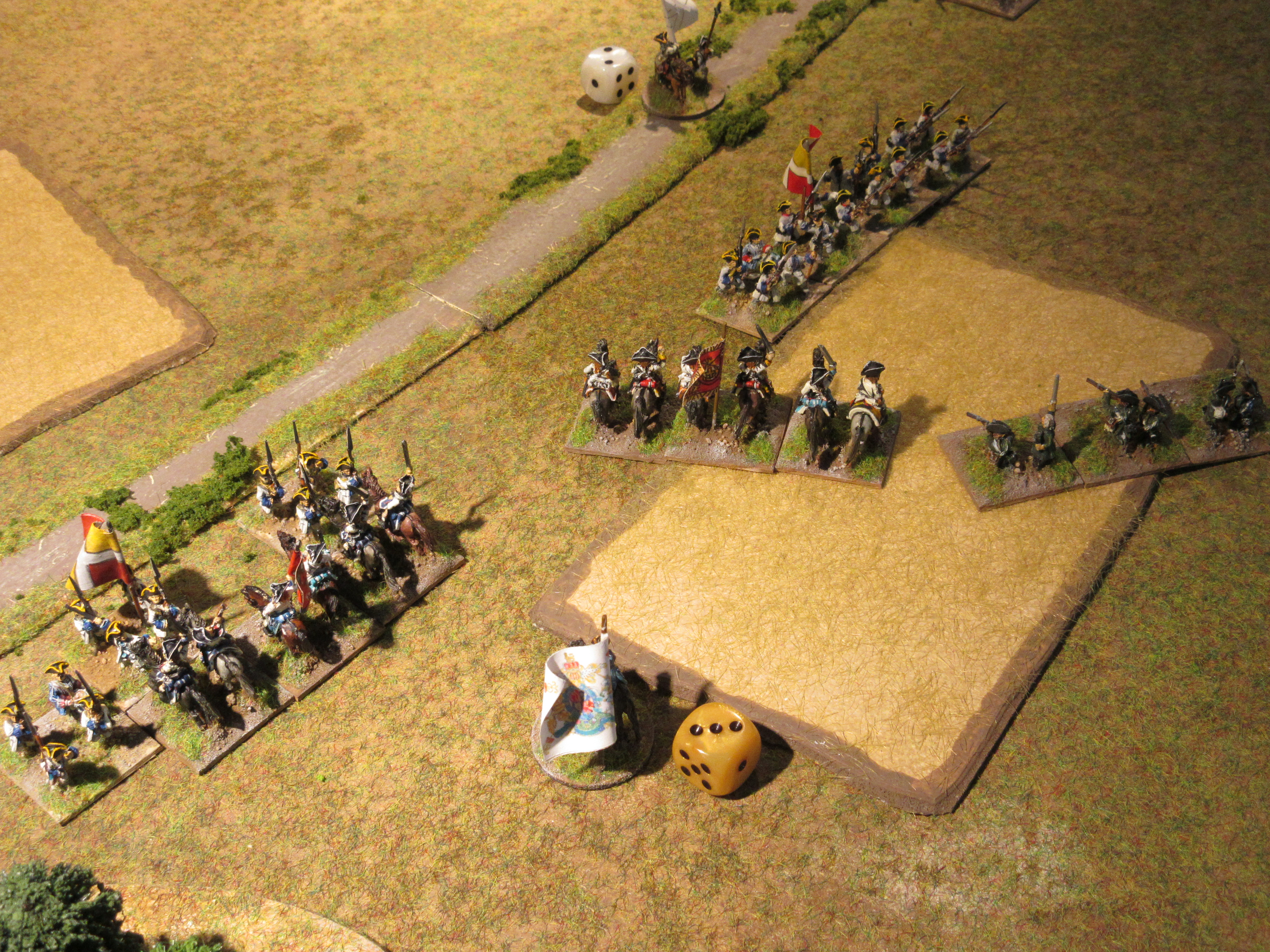
Currently, the scenarios are being tested with France in conflict against Hannover. I have added a few photos, a taste of things to come.


donderdag 1 mei 2025

Prussia

The project of rebasing and refurbishing the Seven Years War collection is nearly complete.  There remain 25 elements of cavalry, these are slowly being parcelled out to various armies, but this is not an urgent issue. Looking back at the enormity of the project, I am greatly relieved to see its end. The variant rules (see link) are done and the tests have proven satisfactory, the final step now are the scenarios. 

But for now, the Prussians

Musketeer regiments.

A second battalion has been added to a number of regiments, seen in the photo are Winterfeld infantry, 2 battalions, Braunschweig-Bevern, 1 battalion and Itzenplitz, 1 battalion.

Second photo, Lehwaldt infantry, 2 battalions, Forcade infantry, 2 battalions and Kalckstein, 1 battalion.

Fusilier regiments.

These are 2 battalions of the Brandes Fusiliers and 1 battalion of Sers, later Diericke Fusiliers.

Converged Grenadier battalions.

The grenadier companies of two musketeer regiments formed a battalion, represented here are Bandemer, Kanitz, and Ramin. Converged grenadier battalions did not carry standards.

Frei battalions and Jägers

These are the fusiliers of the Frei battalion Mayr, later with the addition of a second battalion it became a regiment. Jäger detachments were common among the Frei corps and volunteer units.


Cuirassiers

Pictured here are the Cuirassier regiments, von Gessler and Markgraf Friedrich von Brandenburg.

Dragoons

Pictured here are the Dragoon regiments, Markgraf Friedrich von Bayreuth and von Schorlemmer.

Hussars

The three regiments here represent, von Zieten, von Reusch plus Bosniak lancers and Wechmar.

Artillery

Battalion guns and heavy artillery.